Hello, it's Heather here! I realised a few hours ago that I've accidentally avoided reviewing any books that our English Literature class has studied, which is odd considering how good they've all been. So, here's one on The Great Gatsby.
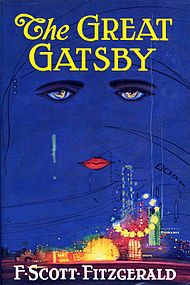
Author: F. Scott Fitzgerald
Published: 1925
Publisher: Charles Scribner's Sons
My
rating: ★★★★
The
symbolism is so obvious in this book; it’s like a canary yellow car hit you
with the hidden meanings. It’s quite understandable why The Great Gatsby is
well-renowned in the English Literature world, flick to any page and it’s like
a recipe for how to write a decent novel (2 tablespoons of foreshadowing, 100
grams of metaphors and a pinch of alliteration). If you haven’t already read
The Great Gatsby, then do it right now.
Fitzgerald
echoes his own relationship through the novel, making the reader feel pity for
Gatsby upon first reading. Some of the writing is beautiful, like how Daisy
blossomed like a flower for Gatsby on their first kiss. There should be more
books set in the Jazz Age; it is simply an enchanting time for a story to be
set, what with the glamour and sparkles of the rich mixed with the many people
unable to quite reach it. The plot itself is intriguing, especially thanks to
Nick, who I loved as a protagonist. Nick lies so many times, he paints himself
out to be virtuous and humble and positive, and outwardly it may seem that this
is true – but the true Nick is jam-packed with judgement, he is so unbelievably
blunt and conclusive that it’s almost laughable. I suppose this is all part of
the green-light illusion, Nick can see this version of himself, but it’s
untouchable in a society where materialism is valued so highly. The American
Dream is far from the main focus of the novel, but having just looked at Merton
in sociology, I can certainly see how strain theory is in place. Gatsby being
the working class boy that dreamt of a grand lifestyle only obtainable through
illegitimate means and having fully gained the respect and rewards he wanted
via these methods. The ambiguous nature of a lot of the book makes it
interesting to analyse, we never truly know if Gatsby tells Nick the truth, we
never quite learn how Nick ends up in most scenarios or why he feels that if he
does not interfere or reveal any secrets, he will be the better man.
As I said
before, symbolism is paramount in the book. Literally everything can be seen in
a different way, which makes it fun to write essays about… take the green light
at the end of Gatsby’s dock and ponder these three explanations. Green is corresponded
with safety, so Gatsby wistfully looks upon the light as he thinks of his
family and the quiet life he left behind in exchange for quite a savage world
of gangs and parties. Green can be associated with healing, so Gatsby wants
someone to mend the heart that has been hurting for such a long time now. In
some countries, green is the colour of money so he yearns for more and more
money, mirroring that consumerist life the upper class indulged in. The list
goes on, but you get the picture. I remember writing my notes about The Great
Gatsby and coming across a random comment about purchasing oranges and lemons –
this was so exciting for me that I soon had a substantial debate outlining how
these objects clearly showed that Gatsby is being mocked by a song about bells for
having a lack of morals (chances are he just liked fruit, or Fitzgerald wanted
to demonstrate his wealth). Sadly, that chunk of notes has never made it into
one of my essays, but I wait in anticipation for the day someone asks me about
the significance of oranges and lemons featuring in The Great Gatsby.
It's good to
consider love in the book, since nobody really gets a fairy-tale ending;
reciprocated true love is arguably absent from the book. Shani and I are huge ‘shippers’
of Nick and Jay – Nick even says his smile was gorgeous! Nick is so blinded
with admiration that the book is smothered in positive language about Gatsby despite
several others claiming he’s got some dodgy money-making ways and is rumoured
to be related to very scandalous people indeed. Gatsby grins and Nick swoons
like my fellow bloggers do when I present them with hardback books. Gatsby does
not reciprocate and seems to be completely oblivious, which is probably a good
thing considering the historical context.
This book
review was more of a ramble (and an excuse to finally pent out my love for
oranges and lemons), so apologies for that, but let me know what you thought of
The Great Gatsby if you have read it.
