Showing posts with label Science Fiction. Show all posts

Tuesday, 15 August 2017

Black & White

Hiya, it’s Heather posting today! Hope you’re all having a super summer, I’m not particularly well at the moment so apologies for a shorter than normal review. Many thanks to the author for letting me read this in exchange for an honest review.

Information

Author: Nick Wilford
Published: September 2017
Publisher: Superstar Peanut
Length: 180 pages
Genre: Young Adult, Dystopian

Brief Description (from Amazon)

What is the price paid for the creation of a perfect society?

In Whitopolis, a gleamingly white city of the future where illness has been eradicated, shock waves run through the populace when a bedraggled, dirt-stricken boy materialises in the main street. Led by government propaganda, most citizens shun him as a demon, except for Wellesbury Noon – a high school student the same age as the boy.

Upon befriending the boy, Wellesbury feels a connection that he can’t explain – as well as discovering that his new friend comes from a land that is stricken by disease and only has two weeks to live. Why do he and a girl named Ezmerelda Dontible appear to be the only ones who want to help?

As they dig deeper, everything they know is turned on its head – and a race to save one boy becomes a struggle to redeem humanity.


Review

This novel is set in a spotless society (they’d despise my house) called Whitopolis in which even the word dirt is confusing to the citizens. One day, a kid named Mallinger from another place suddenly appears there – and this boy is covered in dirt, so naturally the citizens are terrified and condemn him as a ‘demon’. Meanwhile, Wellesbury is bored of how routine and perfectionistic their lifestyle is, so talk of a ‘demon’ intrigues him and he decides to investigate.

I found the concept of living in an immaculate society really creative. There’s no illness, most people live until they’re a hundred, and everything is fairly uneventful. This did rub off on some of the characters too. With the exception of Wellesbury, Ezmerelda and Tindleson, everyone living there seemed content with their lives yet were distant, passive and dull, almost lacking any energy. Wellesbury was a good protagonist; I really liked how innocent he was, harbouring a sweet crush for Ezmerelda and wanting to help Mallinger, but also struggling with his peers as school. Ezmerelda was animated and passionate, her bravery and thirst for justice making her very likable and a strong character. To be honest, I felt that Tindleson was introduced too late on in the book and seemed to very suddenly gain the trust of Wellesbury and Ezmerelda.  

“Her eyes had colour. Her skin had colour. Ezmerelda longed for more colour in her world.”

Sometimes, I found myself yearning for just a little more imagery – it’s particularly hard in fantasy and science fiction books because the reader needs to feel convinced that the place could exist. It’s the little things like the shade of the paving slabs, descriptions of the hovercars and food, did they have garages? Was there any fake grass or stone patches or was the outside completely concrete? Did they have windows and statues? Teensy details like the sound of one’s footsteps on different materials can really help to develop a sense of realism for the reader. The whole concept of eradicating anything vaguely unclean does make one question how toddlers were dealt with pre-toilet-training stage and whether dust was an issue. Were paint stains frowned upon? I know that a certain amount of information should be left to the imagination, but I’m a curious person and the idea of Whitopolis sparked my interest, so these questions bugged me.

I enjoyed this novel, but felt it needed just a little bit more description. The grammar was flawless, though there was an overuse of ellipses at the start. If you’ve read it, let me know your thoughts below!  

Tuesday, 25 July 2017

A Passport to a Nation of Talking Slugs and Other Stories


Hello, it's Heather here. This has to be the most peculiar title for a book we’ve ever received, so my expectations for creativity were certainly high. As it’s a collection of short stories, I decided to structure my review differently for it. Many thanks to the author for letting me read this in exchange for a review.

Information

Author: Andrew Kozma
Published: August 2016
Publisher: Self-published
Length: 44 pages
Genre: Science Fiction, Fantasy, Short Stories

Brief description (from Amazon)

A Passport to a Nation of Talking Slugs is a collection of weird, speculative fiction containing four stories of people exploring strange places and situations, from a newly-discovered civilization of six-foot-tall talking slugs to being haunted by a man in a dark chocolate suit. Whether waking up in a prison camp or navigating a city full of copies of themselves, the characters in these stories are bent on understanding their world, even if that understanding also means the end of the world they thought they knew.

Andrew Kozma’s fiction has been published in Drabblecast, Albedo One, Interzone, and Daily Science Fiction. His book of poems, City of Regret (Zone 3 Press, 2007), won the Zone 3 First Book Award. His previous collections of short fiction are The Year of the Stolen Bicycle Tire and Other Stories and You Have Been Murdered and Other Stories.

(https://www.amazon.co.uk/Passport-Nation-Talking-Slugs-Stories-ebook/dp/B01HBYOE18)

Stammlager 76

The first short story is an ominous tale about a man that finds himself in Stammlager 76, a sort of prison, with no recollection how he got there, or an inkling of how/when he would be released.

“The weather was complicit, the clouds always hovering above like a woolen blanket, so textured, so gray, that the sky itched just to look at it.”

Kozma does a spectacular job at setting the atmosphere in this little story. I hope he doesn’t mind that I’ve included my favourite quote above – what a wonderful line! Whilst concise, as needs be in a short story, his description captures the mood beautifully, using the simile of the clouds being an itchy blanket to reflect both the dark, almost claustrophobic entrapment of the sky (usually a symbol for freedom in literature), and also the frustration of the narrator, as well as the foreboding sense of being watched from the verb ‘hovering’. This thoughtful style of description is apparent in all of his stories. I did, however, feel that the story should have been a little longer, even if it was just an extra page to provide more development on how the narrator settles in, or a scene in which he meets other prisoners (aside from Aaron).

The Man in the Dark Chocolate Suit

This one is about a man dressed in a dark chocolate suit that haunts the narrator and his friend Joe, appearing everywhere he goes.

This story immediately draws the reader in; this time using dialogue first to exert urgency before settling into the, again very well written, description. It’s a well-executed short story very reminiscent of the ghost stories I recall hearing at Brownie camp that’d leave everyone with bad dreams (but in a far eloquent style). My main criticism is that I’d have liked more in the in-between stages of this one, more about how the taunting figure of the man in the dark chocolate suit irked the narrator, why he appeared and how, though the ending of the story was very good.

We of the Future are the Ghosts of the Past

As the title insinuates, this tale uses the symbolic interactionist idea of people having different versions of themselves as we change so drastically over time. It also focuses on death.

This is my favourite story in the collection. Remarkably creative, surreal, and tragic in the most composed manner. Not only does it examine the self, but also the way love alters over time. Sure, like the other stories, there are many unanswered questions, but I really loved the ambiguity of it, letting the reader come up with their own theories. I also liked the length of it, it felt whole, the reader can be attached to the narrator without requiring any of his background, which is really difficult for short stories to achieve. The paragraph about her voice is exquisite, such a pure and lovely way to show his feelings towards her.
Another (slightly random) thing to commend for the author on here is that they actually understand death! There are so many novels I’ve read that romanticise death without comprehending that, yes, gas is released and muscles relax, so there will be a… smell… it’s gross but realistic, and slightly ruins every magical moment when someone dies and their partner cradles their dead body… which leads me to the question: did Harry Potter go through this process when he kind of died in the last book?

A Passport to a Nation of Talking Slugs

At the title of this novel, of course I was curious about the whole slug thing, and I have to say that I was not disappointed. Taking a more light-hearted style, this is literally about Roger going on holiday to Slugland, which is inhabited by giant slugs.

“…but I’d never believed I’d actually see a slug as tall as a man, wearing a fanny-pack, carrying a briefcase.”

Quite possibly the best quote I have ever included in a review. I cannot express my joy at having gone from three albeit very deep and eloquent short stories to this. It’s not often that writers can write well in both comedic and serious tones. The writer clearly had a lot of fun with this one, it’s uplifting and amusing. Roger himself was very distant, I’d have liked to have understood the appeal to going to Slugland more. Was it a little bit too weird for me? I’ll admit, the relationship between Roger and Shelly was concerning and perhaps a little too bizarre for me.

All four stories show an immense amount of creativity and are a fun, quick read.

Saturday, 31 December 2016

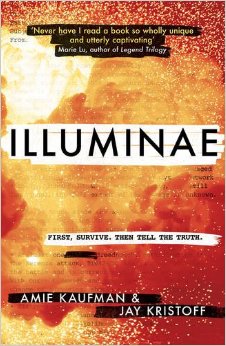
Illuminae by Amie Kaufman and Jay Kristoff

Rating: 5/5
Authors: Amie Kaufman & Jay Kristoff
Published: 20th October, 2015
Publisher: Oneworld Publications/Rock The Boat

Hello everyone, it's Shani here, and today I wanted to express my opinions on the book Illuminae by Amie Kaufman and Jay Kristoff.

Illuminae is the first novel in the Illuminae Files trilogy. When I bought this book, I had already heard some amazing things about it - the novel has been praised for its style and narration by numerous other book reviewers, and let you tell me this. This book met every single one of my reading standards, and somehow managed to raise them as well.

Illuminae was my second favourite book that I've read this year. It has one of the most gripping story lines I've ever encountered, hooking you from the very first page, and keeping you on the edge of your seat through out the entire book. Kaufman and Kristoff have presented a YA, sci-fi novel in the least cliche manor possible, and I loved it.
I'm not much of sci-fi reader. I've tried in the past to read many sci-fi books, but I've often found that the plot is too predictable, or that the story is reaccuring. That's not to say that Illuminae's plot is miles different from other sci-fi novels. In fact it isn't. It has all the cliche settings: It's in space, there's fighting, there's an uncontrollable virus that is turning people crazy and reducing them to killing one and other. It's your typical sci-fi novel. What was different was the way it was presented. The book is presented entirely through files, legal documents, chat messages, emails, and security camera footage. I have never found a single author that has formatted their novel this way, and I absolutely applaud Kaufman and Kristoff for experimenting with this style, because it works so well!

The plot, though it involved some typical sci-fi tropes, was fairly original in certain areas. The novel centres around seventeen year old Kady Grant and Ezra Mason who have just escaped from their planet being destroyed by an evil corporation named BioTech. The novel takes place in 2575, yet the authors still manage to keep the novel relevant to their audience, the language they use and the appropriate pop culture references really made me able to relate to the characters in the novel, despite them being thousands of years in the future.

This doesn't start of slowly at all, it throws you straight into action - which was one of the main reasons I adored it so much. I tend to get bored very quickly when reading unless the story really grips me, I tend to find classics hard to get into for example, because the first few pages are normally quite slow, thus I tend to have to force myself to read them just to be able to pursue the rest of it. Illuminae is one of the very few books where I didn't have to do this. I was interested and invested from the very first page, and it was very refreshing!

Another excellent point about Illuminae is the character development. Oh, golly. The character development in this book is incredible. Not only does this book have an incredibly strong, intelligent, and snarky female protagonist, but Kady's character development is wonderful. She endures loss, she makes mistakes, she is presented to the reader as a real person with flaws and I loved this about her.

Illuminae is now in my top ten favourite books that I've ever read, and I'm so excited to read the sequel Gemina, which came out a few months ago!

Friday, 23 December 2016

Once Upon A Winter

Hello, it’s Heather here! I hope all those celebrating Christmas are having a wonderful time, I was in the midst of panicking over last minute Christmas presents when our book blog received an email granting us access to read this enchanting novel! Initially, I danced in joy with the thought that if the book was good, it would make a charming present, but now I see that the book would look at home in my own bookcase (and only the best books are allowed on there). I think the other two will also be reviewing this one shortly too.

Author: Melyssa Williams
Published: November 2016
Publisher: Red Team Ink

This book is so heart-warming, I struggled to tear myself away from reading it. For this time of year, it is absolutely ideal. I found myself immediately relating to the protagonist, Ree, who dreaded her family’s Christmas party for the many awkward encounters the night would probably entail (let’s face it, sometimes we’d much rather be curled up reading a book), but also looked forward to her godfather’s inventions with mounting anticipation. And wow, they were certainly impressive gifts. Being a keen mechanic herself, Ree helped to create the first one, but the next two were shocking even for her. The plot took a swift turn as he presented the guests with two clockwork figures, both of which enthralled Ree with their realistic quality – this section has some really brilliant imagery, so you feel the same excitement as Ree does. Her fascination with the dolls leads her to a thrilling adventure out of the comfortable world she had become somewhat bored with.  
The style of the book reminded me of Phillip Pullman, which I was delighted with, being an avid fan of this type of book. The world it’s set in is similar enough to ours to make it easy to visualise, yet refreshingly magical with some nice fantasy features, most of which I haven’t seen before, like the reindeer children. I was talking with a friend the other day about how fantasy is a genre that has so much potential – limitless possibilities – and can be stunning when the author puts in the effort to communicate the little details, this book certainly falls under this category. Many masterpieces are from this area, think of Harry Potter, The Hobbit and Lord of The Rings trilogy – these are all such successful and cherished stories because the author successfully whisked us away to somewhere new, where we could follow captivating adventures. The usage of clockwork was very different and well executed.
Ree is such a great character to lead the story, firstly because she’s a girl that spends little time waffling and is blunt about what she thinks without appearing rude or conceited, also as her sarcasm and sass is faultless and to top this, she admits any mistakes she makes. She goes stubbornly against what her sister claims is proper; yearning for adventure, passionately delving into mechanics even before the novel is set and actually fighting when necessary. Every ounce of fear and happiness that she feels is radiated through the language: she is not fearless, labels herself as claustrophobic at one point and screams a fair amount later on in the book. I think it’s important for authors to address that being scared is not weak, at no point does Ree stand up and say “Okay guys, this was fun but now I want to go home,” and walk away, that’s what really matters. Another plus point to her character was that though she often admired the boys, the story does not end with a cliché and emotional kiss, nor does she spend a long time pondering dates. I look forward to when the author writes a sequel (please write one) so these kinds of relationships can form, but the chemistry between Ree and Nikolai was perfect.
If you want a nice book to keep you company on these long and cold winter days, I would highly suggest this one. I’ve included some links below to help you all find it and hope that you do so. This author has so much potential, I cannot wait to read her next book and feel she will definitely grow in popularity soon!

Sunday, 24 July 2016

The Invisible Man

Hi, this is Heather! Sorry for not posting in a while, we've all been rather busy with the start of summer :) 

Author: H.G. Wells
Published: 1897
Publisher: Originally, it was published in Pearson's Weekly, but Penguin published my copy!
My rating: 4/5

Strangely enough, it took until chapter four that I was certain the main man in the story, Griffin, was (spoiler alert for those that never think of the obvious reasons, like myself) invisible. I was sure at first that the invisibility was simply a metaphorical idea, or perhaps that the man was so grotesque that he wanted to be invisible. For those unfamiliar, the plot is quite basic – Griffin is an invisible man, at first he seems to be struggling yet succeeding in concealing this, but later the invisibility is revealed and he goes a little bit crazy. ‘A little bit’ being an understatement since he wants to kill any human that disobeys him. My query to other readers is to consider what is worse: being looked at with disgust due to how you look, or fear due to not being seen? This concept really intrigued me as I progressed through the book, particularly as I have recently read Frankenstein with my fellow bloggers in class. Humanity is so used to being prepared for situations and taught what to do that when something peculiar or abnormal appears; they sometimes panic and lose all rationality.
I found the last few chapters especially enthralling and was disappointed when the book ended. If I am honest, some aspects of the start of the book were confusing – for instance, having the protagonist referred to as ‘the stranger’, making the reader feel distant instead of close to them. These questions were answered later on though and made the explanation behind them all the more curious, so I can see why Wells did this. I did not look very favourably on any of the characters, or get to really know any of them all that well! One of my teachers once remarked how the best authors can make the reader enjoy a novel despite hating the characters within it and that is certainly true for this book. In the world created by Wells, kindness is scarcely seen and hence no one seems to have any sympathy towards the invisible man, and he does not appear all too capable of being nice himself.
Understanding the motives of Griffin in more depth would have made this book peek to five stars; I felt as though his hatred for humanity was a bit random. At first, he was content to rob a little but not kill or hurt anyone severely, yet this changed drastically when his invisibility was exposed. Granted, the isolation and insecurity of having others judge you harshly for literally nothing would provoke anger, but surely Griffin could empathise with visible humans, having been one previously: it struck me as odd that he did not consider their perspective. Maybe the experiment altered him mentally, or the lack of human contact made him go a little crazy, but nevertheless I would have liked to have been in Griffin’s head a bit more in order to have understood him. 
Another concept of the book I’d like to discuss is power. To Griffin, having the ability to dance around the other humans without the acknowledgement of being there has the same affect as some find in a shot of vodka – he feels confident, invincible and mighty, ready to initiate the ‘reign of terror’. He was like a poltergeist in a horror film, the ease to provoke fear in others only further inflating his ego. I found myself pitying the victims that had had the misfortune of coming across him. Even before becoming invisible that poor kitty is tested on with a horrendous lack of mercy, which made me lose any sympathy I had for him earlier.

I did really enjoy reading this book and found it a good size for storing in my handbag to read whilst on the train or waiting for appointments. The science-fiction with horror combination is not appealing to everybody, but for those that do like an action-packed story I would certainly suggest reading it. I can definitely see some inspiration from Shelley the way that Wells put scientific explanation to fantasy ideas to evoke themes of horror.

Sunday, 3 July 2016

Delirium

Hiya, it's Heather! Here's a little post on Delirium, I ramble a bit here, so apologies in advance but I hope you enjoy regardless ^-^

Author: Lauren Oliver
Published: January 2011
Publisher: Harper Collins

In a state of procrastination, I found myself scrolling down the social science fiction Wikipedia page, one of the listed books being Delirium. The plot is the part which initially drew me to reading it, to sum it up: Lena lives in a society where love is seen as a disease, so is completely forbidden, thus when deemed old enough the individual will be assessed and then paired with a partner, a little after this they are injected with a substance that revokes the instinct to fall in love.  
The general idea of the novel is impressive to say the least. A fundamental aspect of our culture is that love is positive, be it through Disney and children’s television to horror and comedy films. It hence struck me as intriguing to go to a world whereby love is a disease. This led my thoughts into how some people view certain types of love negatively because of that socialisation they have had teaching them so, sadly homosexuals are sometimes thought of this way by certain people. Could it be that Oliver is trying to demonstrate that love is always positive?
The plot was brilliant and the general pace of the novel fast, making it an easy read. There’s a point where Lena and Alex, whose a boy that changes her perspective on love being diseased, dance which is adorable (I squealed and started singing Taylor Swift under my breath). The ending was on a real cliff-hanger and to be honest I would have read the next book immediately. HOWEVER, I read reviews on what the next one is about to avoid the book being scarred and found that there is a love triangle situation! I am not patient enough to read about another girl that cannot pick a boy – if you cannot choose between two boys, your feelings for them are not strong enough to be considered true love. Anyway, back to Delirium… Hana (Lena’s bestie) was a fantastic character. She’s that typical friend that challenges you to go out of your comfort zone and tells you to ‘chillax’ despite having few moments of spontaneity themselves.
Whilst I must underline that the book was an enjoyable read which I devoured in less than a day, there were some elements of it that I feel could have been improved. For instance, the start of the book was so focused on getting the reader to comprehend the social situation that the description was somewhat lacking. Though I do understand that this can be really hard when a vital aspect of the story must be obvious to the reader and a rose cannot grow without the soil being laid down first, it did frustrate me at first. Also, Alex, the male love interest in the novel, was frustratingly persistent to the point where he reminded me of Gatsby from The Great Gatsby. The protagonist was terribly rude to him at the start, making her intentions to stay away from him so clear (as was protocol in a place with gender segregation laws) that I thought it odd that he still tried approaching her. It can be argued that love makes people try hard to gain the affection of those they feel attracted to, yet I think when anyone is that obvious that they want to stay away you should respect that decision. Furthermore, Lena very suddenly changed her attitude towards him; she went from hating this guy to spending nearly every day with him? The last point I would like to address is that Lena is very difficult to visualise, maybe she’s very humble or maybe I skipped a page but Lena is scarcely ever described except as short and not pretty but not ugly. This is great but what about hair colour, eyes, for all I know she could have a tattoo of a badger on her leg. Also, a little game for you, count the amount of times that Lena is sweating because I’m worried about her.
What did I do after finishing this book? I cried. I'm a sucker for romance and I genuinely really loved this one (regardless of the sweating problem). If you want a cute love story involving internal conflict and teenage rebellion then I would definitely tell you to read it.

Alright, if anyone has any thoughts on Delirium then I'd love to hear from you! Have a lovely day or night or in between.