Showing posts with label Dystopian. Show all posts

Tuesday, 15 August 2017

Black & White

Hiya, it’s Heather posting today! Hope you’re all having a super summer, I’m not particularly well at the moment so apologies for a shorter than normal review. Many thanks to the author for letting me read this in exchange for an honest review.

Information

Author: Nick Wilford
Published: September 2017
Publisher: Superstar Peanut
Length: 180 pages
Genre: Young Adult, Dystopian

Brief Description (from Amazon)

What is the price paid for the creation of a perfect society?

In Whitopolis, a gleamingly white city of the future where illness has been eradicated, shock waves run through the populace when a bedraggled, dirt-stricken boy materialises in the main street. Led by government propaganda, most citizens shun him as a demon, except for Wellesbury Noon – a high school student the same age as the boy.

Upon befriending the boy, Wellesbury feels a connection that he can’t explain – as well as discovering that his new friend comes from a land that is stricken by disease and only has two weeks to live. Why do he and a girl named Ezmerelda Dontible appear to be the only ones who want to help?

As they dig deeper, everything they know is turned on its head – and a race to save one boy becomes a struggle to redeem humanity.


Review

This novel is set in a spotless society (they’d despise my house) called Whitopolis in which even the word dirt is confusing to the citizens. One day, a kid named Mallinger from another place suddenly appears there – and this boy is covered in dirt, so naturally the citizens are terrified and condemn him as a ‘demon’. Meanwhile, Wellesbury is bored of how routine and perfectionistic their lifestyle is, so talk of a ‘demon’ intrigues him and he decides to investigate.

I found the concept of living in an immaculate society really creative. There’s no illness, most people live until they’re a hundred, and everything is fairly uneventful. This did rub off on some of the characters too. With the exception of Wellesbury, Ezmerelda and Tindleson, everyone living there seemed content with their lives yet were distant, passive and dull, almost lacking any energy. Wellesbury was a good protagonist; I really liked how innocent he was, harbouring a sweet crush for Ezmerelda and wanting to help Mallinger, but also struggling with his peers as school. Ezmerelda was animated and passionate, her bravery and thirst for justice making her very likable and a strong character. To be honest, I felt that Tindleson was introduced too late on in the book and seemed to very suddenly gain the trust of Wellesbury and Ezmerelda.  

“Her eyes had colour. Her skin had colour. Ezmerelda longed for more colour in her world.”

Sometimes, I found myself yearning for just a little more imagery – it’s particularly hard in fantasy and science fiction books because the reader needs to feel convinced that the place could exist. It’s the little things like the shade of the paving slabs, descriptions of the hovercars and food, did they have garages? Was there any fake grass or stone patches or was the outside completely concrete? Did they have windows and statues? Teensy details like the sound of one’s footsteps on different materials can really help to develop a sense of realism for the reader. The whole concept of eradicating anything vaguely unclean does make one question how toddlers were dealt with pre-toilet-training stage and whether dust was an issue. Were paint stains frowned upon? I know that a certain amount of information should be left to the imagination, but I’m a curious person and the idea of Whitopolis sparked my interest, so these questions bugged me.

I enjoyed this novel, but felt it needed just a little bit more description. The grammar was flawless, though there was an overuse of ellipses at the start. If you’ve read it, let me know your thoughts below!  

Thursday, 10 August 2017

The Year of the Flood

Hello, it’s Heather here. Lydia lent me this novel earlier, and after finishing it I just had to write about it! I had no idea that this was the second of the trilogy until after reading it, though from the comments I’ve read online this seems to be linked, but not necessarily attached, to its predecessor. There are sexual and violent themes in this book so it’s probably best for under-eighteens not to read it.

Information

Author: Margaret Atwood
Published: September 2009
Publisher: Bloomsbury (UK), McClelland & Stewart (Canada)
Length: 448 pages
Genre: Speculative/Dystopian/Feminist Fiction

Brief description (from Goodreads)

"The Year of the Flood" is a dystopic masterpiece and a testament to Margaret Atwood's visionary power.

The times and species have been changing at a rapid rate, and the social compact is wearing as thin as environmental stability. Adam One, the kindly leader of the God's Gardeners--a religion devoted to the melding of science and religion, as well as the preservation of all plant and animal life--has long predicted a natural disaster that will alter Earth as we know it. Now it has occurred, obliterating most human life. Two women have survived: Ren, a young trapeze dancer locked inside the high-end sex club Scales and Tails, and Toby, a God's Gardener barricaded inside a luxurious spa where many of the treatments are edible.

Have others survived? Ren's bioartist friend Amanda? Zeb, her eco-fighter stepfather? Her onetime lover, Jimmy? Or the murderous Painballers, survivors of the mutual-elimination Painball prison? Not to mention the shadowy, corrupt policing force of the ruling powers . . .

Meanwhile, gene-spliced life forms are proliferating: the lion/lamb blends, the Mo'hair sheep with human hair, the pigs with human brain tissue. As Adam One and his intrepid hemp-clad band make their way through this strange new world, Ren and Toby will have to decide on their next move. They can't stay locked away . . .

By turns dark, tender, violent, thoughtful, and uneasily hilarious, "The Year of the Flood" is Atwood at her most brilliant and inventive


Review

Boldly inventive as always, Atwood definitely succeeded in crafting an eerie story following two women that join a religious group called the Gardeners and following their lives before and after, and how they manage to survive the man-made, water-less 'flood'.

The narrative is a little messy at times, sometimes I had to flick back to check what time the chapter was set in and whether it was Ren or Toby. I think it might have worked better starting from the beginning, instead of year twenty-five. Every now and then, there’s a speech given by Adam One on a special event or day. At the start of the book, these really confused me, I had no idea what they meant in the context of the book, nor did I know who most of the referenced characters were. Had I read this novel for analytical or educational purpose, as oppose to leisure, I would probably have actually read these bits, but instead I found myself skipping past it to get to the narrative. These were bits were followed by hymns – which would have been a lovely touch – but again, I wanted to stay attached to the story, and it’s much better to hear or sing a hymn than to read it, so they were normally skipped too! In true Atwood style, when it ends you expect there to be another page or chapter; maybe the last novel in the series covers all the unanswered questions.

Like in The Handmaid’s Tale, Atwood includes charming little touches to her writing, for instance Toby contemplating the word daybreak and whether the sun or the night are splitting. Her writing remains as bold as ever, venturing into some dark and sensitive themes and using a lot of symbolism. I’d rather not get too bogged down on the whole meat debate as it’s pretty controversial for everyone, but I did find it interesting to look at, despite Ren and Toby’s view being overly one-sided in terms of religion (consider that Jesus frequently ate meat). I was reading up on Atwood earlier and it’s mentioned that she links meat-eating to sexual oppression sometimes, so perhaps this was done on purpose to show how, as women, they were oppressed. Utilising this idea, it’s no wonder that the SecretBurgers (a blend of whatever meat, and sometimes fingernails, could be found) made several appearances; maybe a symbol for the disturbing presentation of sex.

The world itself felt tiny, main characters running into one another so frequently that I wondered if Atwood was doing this to infer fate or just a lot of coincidences in a small place. As characters go, I’ll admit that sometimes Nuala and Pilar somehow got muddled up in my head, the Gardeners being similar in dialogue, but this kind of made me think that the bee hive was a symbol for them – moving as one with the same flow of thoughts. Little Ren was very sweet and easily influenced by Amanda; I really liked how Atwood wrote Ren’s guilt and sense of betrayal as she grew up, sometimes finding their lifestyle difficult and yearning to dress like the other children did. Zeb was a powerful character, filling a role as a fatherly figure to Ren, which the novel was otherwise pretty absent from, aside from perhaps Toby being maternal towards her. I liked how the novel portrayed friendship as more powerful than romantic love.

This brings me onto the next subject: sexual and romantic love. Throughout the novel, Toby is described by Ren as the dry witch, completely un-sexual and hardcore. I really think this demonstrated the way that Blanco’s abuse of her destroyed her sense of sexuality, contaminating the very idea of romance. Ren herself has some bad experiences with love as well, and it’s written wonderfully, really illustrating the many ways love can hurt you. All in all, romantic love is presented as painful and damaging.

Perhaps this is what makes the narrators both feel so isolated. Ren is quiet, but in her head, it’s obvious that she’s having to deal with a lot of issues alone and unsupported in a truly selfless manner. Toby also comes across as isolated, feeling abandoned regularly by those she loved and having to hide her own doubts to fit in. It was fascinating to see how Toby settles into the Gardeners, particularly as she frequently expresses a difficulty to believe like they do, and yet she finds herself at home there. The theme of disguise and concealment was another element that Atwood presents as important. Toby is constantly trying to blend into the background, be it by joining the Gardeners to escape from Blanco, and by physically changing her appearance. This idea almost makes unique identity and individuality appear negative, making even the self lonely.

Personally, I found the novel difficult to initially get into and the structure a little awkward, but it’s definitely worth persisting with. The storyline itself develops nicely, making it enticing and scary to read. 

Saturday, 31 December 2016

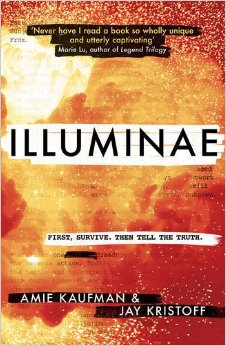
Illuminae by Amie Kaufman and Jay Kristoff

Rating: 5/5
Authors: Amie Kaufman & Jay Kristoff
Published: 20th October, 2015
Publisher: Oneworld Publications/Rock The Boat

Hello everyone, it's Shani here, and today I wanted to express my opinions on the book Illuminae by Amie Kaufman and Jay Kristoff.

Illuminae is the first novel in the Illuminae Files trilogy. When I bought this book, I had already heard some amazing things about it - the novel has been praised for its style and narration by numerous other book reviewers, and let you tell me this. This book met every single one of my reading standards, and somehow managed to raise them as well.

Illuminae was my second favourite book that I've read this year. It has one of the most gripping story lines I've ever encountered, hooking you from the very first page, and keeping you on the edge of your seat through out the entire book. Kaufman and Kristoff have presented a YA, sci-fi novel in the least cliche manor possible, and I loved it.
I'm not much of sci-fi reader. I've tried in the past to read many sci-fi books, but I've often found that the plot is too predictable, or that the story is reaccuring. That's not to say that Illuminae's plot is miles different from other sci-fi novels. In fact it isn't. It has all the cliche settings: It's in space, there's fighting, there's an uncontrollable virus that is turning people crazy and reducing them to killing one and other. It's your typical sci-fi novel. What was different was the way it was presented. The book is presented entirely through files, legal documents, chat messages, emails, and security camera footage. I have never found a single author that has formatted their novel this way, and I absolutely applaud Kaufman and Kristoff for experimenting with this style, because it works so well!

The plot, though it involved some typical sci-fi tropes, was fairly original in certain areas. The novel centres around seventeen year old Kady Grant and Ezra Mason who have just escaped from their planet being destroyed by an evil corporation named BioTech. The novel takes place in 2575, yet the authors still manage to keep the novel relevant to their audience, the language they use and the appropriate pop culture references really made me able to relate to the characters in the novel, despite them being thousands of years in the future.

This doesn't start of slowly at all, it throws you straight into action - which was one of the main reasons I adored it so much. I tend to get bored very quickly when reading unless the story really grips me, I tend to find classics hard to get into for example, because the first few pages are normally quite slow, thus I tend to have to force myself to read them just to be able to pursue the rest of it. Illuminae is one of the very few books where I didn't have to do this. I was interested and invested from the very first page, and it was very refreshing!

Another excellent point about Illuminae is the character development. Oh, golly. The character development in this book is incredible. Not only does this book have an incredibly strong, intelligent, and snarky female protagonist, but Kady's character development is wonderful. She endures loss, she makes mistakes, she is presented to the reader as a real person with flaws and I loved this about her.

Illuminae is now in my top ten favourite books that I've ever read, and I'm so excited to read the sequel Gemina, which came out a few months ago!

Monday, 11 July 2016

Animal Farm

Hey, it's Heather. This review is about Orwell's Animal Farm!

Author: George Orwell
Published: August 1945
Publisher: Harcourt Brace and Company
My rating: 4/5

When I first took sociology it seemed logical to read Animal Farm, considering that it mingles my two favourite subjects together in less than 200 pages. Somehow this year has flown by and it was just a week ago that I opened the book. My expectations for the novella were raised pretty high; I was even convinced it was fate for me to read this book when I noted that Lydia’s copy of the book had an introduction by Malcolm Bradbury as coincidentally this is the same name as my grandpa. The book is set on a farm featuring several pompous pigs, a herd of sheep that parrot the pigs’ thoughts, a few dogs and horses as well as some other farmyard friends. The animals are assembled at the barn where they listen to Old Major the boar plead that the animals start a revolution against humans once he is deceased. He describes a place where animals control themselves and are no longer forced to commit to tiresome labour until they die. This suggestion of equality appeals to the others and so they go ahead and take over the farmers, starting a farm run entirely by animals. However, the communist ideas thought of by Old Major are soon abandoned as the farm eventually develops into a capitalist establishment where the pigs take the role of humans. I feel the key quote here is that "All animals are equal, but some animals are more equal than others."
Orwell’s writing style is fast-paced, making it a riveting read with very little waffle. Each character is flawed in some way, some are too gullible, others greedy, cynical or deceitful. Furthermore, there is no obvious protagonist as the story focuses on several animals which makes the story all the more interesting as several perspectives are shown. Having read Emma by Jane Austen a few months ago, I am in the habit of writing down the name of every character mentioned but found this unnecessary since Orwell’s characters are each so memorable. These are all definitely advantages of the book, which meant I was able to read it all really quickly without backtracking. The sociology featured is very basic, mostly themed around Karl Marx’s idea through Old Major that the ruling class have instated a ruling class ideology on the others, so they are passive conformists that have been put under false consciousness. This means that the animals on the farm are not aware that they have been mistreated and it takes Old Major to provoke class consciousness (when they realise the exploitations they are subject to) and hence a revolution resulting in communism. The boar also represents Lenin, who contributed to the communist takeover in Russia, notably his successor was Stalin, who is reflected through Napoleon the pig in the book. There is no doubting the intelligence of that pig throughout the story but I severely disliked him. His rival in the novella is another pig, Snowball, who can also be viewed as Lenin in some ways but is more like Trotsky, who worked with Stalin for a while until they disagreed about some of his policies and was consequently exiled from the Soviet Union. There are more famous leaders among sociology scattered around the book, but if you are not particularly passionate in this area I would like to put emphasis on the point that you can read the novella without any of this sociology in mind. I would actually recommend initially reading the book without focusing too much on the background, just as a curious story and then rereading it with more explanation (it’s only 112 pages!).
Generally, I cannot complain about the book, it was like a burst of sherbet – a sharp burst of flavours. Yet the ending was where the sugar rush finished rather abruptly; I’ll be honest, I was disappointed. The ending echoes the words of Benjamin the pessimistic donkey; “Life will go on as it has always gone on – that is badly.” I love a good happy ending with frogs, princesses, emotional hugs and wet handkerchiefs so perhaps this is why I felt slightly saddened at the continuity of misery. Many would insist that this realistic element makes the novella remarkable, and they are probably right yet I just wanted to give Clover the horse a hug (this is odd as I got knocked over by a horse when I was younger and have stayed away from them ever since) and give the animals the future they deserved. Regardless of the ending, it was definitely worth a read and I found several of the ideas expressed very thought provoking. Even though I felt like I was being kicked in the stomach from the lack of cheeriness, the last line of the book was one of my favourites; "The creatures outside looked from pig to man, and from man to pig, and from pig to man again: but already it was impossible to say which was which." For those that do have an interest in politics, history or sociology I would especially urge you to read this, though I think most people will find the subjects covered intriguing. I also need to warn anyone I know that even briefly bringing up Boxer will make me cry.

Once again, I hope you liked the review and will read the book if you haven't already! Any suggestions for books to read are always appreciated.

Sunday, 3 July 2016

Delirium

Hiya, it's Heather! Here's a little post on Delirium, I ramble a bit here, so apologies in advance but I hope you enjoy regardless ^-^

Author: Lauren Oliver
Published: January 2011
Publisher: Harper Collins

In a state of procrastination, I found myself scrolling down the social science fiction Wikipedia page, one of the listed books being Delirium. The plot is the part which initially drew me to reading it, to sum it up: Lena lives in a society where love is seen as a disease, so is completely forbidden, thus when deemed old enough the individual will be assessed and then paired with a partner, a little after this they are injected with a substance that revokes the instinct to fall in love.  
The general idea of the novel is impressive to say the least. A fundamental aspect of our culture is that love is positive, be it through Disney and children’s television to horror and comedy films. It hence struck me as intriguing to go to a world whereby love is a disease. This led my thoughts into how some people view certain types of love negatively because of that socialisation they have had teaching them so, sadly homosexuals are sometimes thought of this way by certain people. Could it be that Oliver is trying to demonstrate that love is always positive?
The plot was brilliant and the general pace of the novel fast, making it an easy read. There’s a point where Lena and Alex, whose a boy that changes her perspective on love being diseased, dance which is adorable (I squealed and started singing Taylor Swift under my breath). The ending was on a real cliff-hanger and to be honest I would have read the next book immediately. HOWEVER, I read reviews on what the next one is about to avoid the book being scarred and found that there is a love triangle situation! I am not patient enough to read about another girl that cannot pick a boy – if you cannot choose between two boys, your feelings for them are not strong enough to be considered true love. Anyway, back to Delirium… Hana (Lena’s bestie) was a fantastic character. She’s that typical friend that challenges you to go out of your comfort zone and tells you to ‘chillax’ despite having few moments of spontaneity themselves.
Whilst I must underline that the book was an enjoyable read which I devoured in less than a day, there were some elements of it that I feel could have been improved. For instance, the start of the book was so focused on getting the reader to comprehend the social situation that the description was somewhat lacking. Though I do understand that this can be really hard when a vital aspect of the story must be obvious to the reader and a rose cannot grow without the soil being laid down first, it did frustrate me at first. Also, Alex, the male love interest in the novel, was frustratingly persistent to the point where he reminded me of Gatsby from The Great Gatsby. The protagonist was terribly rude to him at the start, making her intentions to stay away from him so clear (as was protocol in a place with gender segregation laws) that I thought it odd that he still tried approaching her. It can be argued that love makes people try hard to gain the affection of those they feel attracted to, yet I think when anyone is that obvious that they want to stay away you should respect that decision. Furthermore, Lena very suddenly changed her attitude towards him; she went from hating this guy to spending nearly every day with him? The last point I would like to address is that Lena is very difficult to visualise, maybe she’s very humble or maybe I skipped a page but Lena is scarcely ever described except as short and not pretty but not ugly. This is great but what about hair colour, eyes, for all I know she could have a tattoo of a badger on her leg. Also, a little game for you, count the amount of times that Lena is sweating because I’m worried about her.
What did I do after finishing this book? I cried. I'm a sucker for romance and I genuinely really loved this one (regardless of the sweating problem). If you want a cute love story involving internal conflict and teenage rebellion then I would definitely tell you to read it.

Alright, if anyone has any thoughts on Delirium then I'd love to hear from you! Have a lovely day or night or in between.