Sunday, 13 November 2016

Mental Trauma piece

Hey again guys!
It's Lydia here, yeah I know twice in one day. This piece is also a creative writing homework task, I wrote it about a week ago. But if you could leave me a comment on how it could become better and be improved, that would be great.


“Now Bill, you must speak to me. I am purely here to help you, it is my job,” he said carefully, “It may burst the magnitude of mental tension that has grown inside you.”

I can’t talk about that.  I cower from the pain of these relentless thoughts and can say nothing. I want so badly to speak, to form the words, to feel my tongue glide over teeth in the formation. I couldn’t, I wouldn’t. Speaking of the horror was reliving the experience all over again. The nature as humans is to stay in the comfort and ease of our warm beds, to feel the purple adrenaline lash through the blood pushing our legs to run away from danger. As soldiers we were forced to fight this chemical, to scream no when our minds said go home. It was what the army indoctrinated into every young man who stood ready in khaki green.
 As a boy who had newly turned eighteen when war was declared, I obeyed and was left chained up in my mind as a result.
I watched many people die. But one in particular haunted my thoughts. One afternoon, the Germans were continually pelting shell after shell at us. Each one getting nearer to my battalion, they seemed to scream, “I’m coming for you” then crash and explode as they hit the mud, each one was a growing parasite on my brain. One shell bounced off the cliff of the trench and fell with a clunk. We all waited for the quick death, but none came. It clicked in recognition, that we all wouldn’t join our deceased brothers, but what poured out of the grey can was just as damaging, it flowed like a mustard river, bubbling and teeming in all directions.
“Gas! Gas! Quick boys! Masks on!”
All but one found their mask. We all stood like evacuees waiting and watching. There was nothing we could do. The fog embraced him, crushing his life with invisible force. He fell choking, gargling blood and writhing like a waterless fish. It would be over any second now I thought. He took ten minutes to die. This painful end replayed in the back of my eyes every night, I couldn’t stop my mind from seeing the red foamed lips and yellow stained body. He was the last face I saw until my inner workings were infiltrated by buzzing insects that ate away at my rigid structure, causing the hold on myself to flop and go limp, and my form hit the earth in guilt filled exhaustion.
He and so many more ghosts swarm around inside me asking why I’m alive and they aren’t, and why am I so special that I was granted to live. I simply answer I don’t know. I keep telling them that I don’t want to be here, that I want to die, hitting and slamming my hands against my head to stop the voices.
A conscious keeps reassuring me, but I can’t seem to hear the nurturing voice over the pounding in my brain. In each beat their names are said, Jack, Michael, Jacob, Oliver, William, Robert.
The inner workings of me seemed to twitch, seize and snatch as I recoiled in the memory of each of their deaths.

“Open your mouth Bill. If you won’t do it for yourself, do it for the sake of your wife and children.” He said more agitatedly

“I have nothing to say.”


Imagery to present a character


Hey guys, long time no see! 
It's Lydia here!
Let me know what you think of this piece I wrote on Friday, it was homework from my creative writing class. 
Leave me a comment if you have any opinions to voice.


Can someone clarify the definition of beauty?
 I am not beautiful, my nose is wonky as a bent wire, and one eye is emerald green while the other is pastel blue. I do not have an crystal hour glass figure, its dumpy on top and balanced on thin legs like that of a child’s crayon drawing or a famous Picasso piece. My arms are hard and thick like leather and my hair is not long and luscious, but stubbornly rigid and straw-like.
I am not beautiful.
Yet the girl who sits across from me, Nancy, yes I think her name is, has white moon skin that shines like a light bulb in the mirror, while pinpricks of red blemishes are dotted about her cheeks as though droplets of blood on marble. Her features are structured and cohesive as if God made her with a protractor and ruler, the nose is high with balanced bones, and it curves like a silver spoon to meet a small pink sphere, and each eye is equally blue. Her face is shaped like a cut out heart, sweetly round and sinuous, that meets to join the hairline, the colour of coffee, with faint lines of fire orange that continue to the ends.
 Is this what perfection is?
How can this be while her insides bubble and boil, like an old hag stirring a caldron. With thin snake like wrinkles, that etches out like fork marks that reach her dying, dull and moldy eyes. Her skin isn’t a firm jewel, but limp and loose like a living corpse, with the colours of decease, a yellowing gray form with ageing purple bruises. Her body is bumpy but solid, as her skeletal form peaks beneath dusty skin. It seems that vanity has eaten her decayed soul, as the beast eats the innocent.

Inner beauty is something more I wish to harvest; the beating gold heart is of more worth than a full face.

Tuesday, 1 November 2016

The Handmaid’s Tale

Hello, this is Heather! Lydia just uploaded some fantastic poetry, so if you haven’t already, please do go and read it; her and Shani write beautifully. On the topic of Lydia, she lent me this book a few weeks ago; I haven’t been able to review it for a while since I’ve been ill and pent up with writing UCAs stuff, but here’s a very short review on it.


Author: Margaret Atwood
Published: 1985
Publisher: McClelland and Stewart
My rating: ★★★

This dystopian novel certainly has some moments that make the reader withdraw in revulsion. It takes place after the society has changed, meaning women have no rights to own property or be independent. The narrator, known by the name of Offred, has lost her money, her job, her husband and her daughter because of this revolution. For those of you innocent to the meaning of a handmaid, it is someone hired to have a baby with the man of the family when the wife is deemed infertile. The theme of feminism is adamant throughout as women are exploited and abused by men in this society. Even the upper class, married women feel little love and seem to have no control over their marriage.
I am glad to report there is not much explicit sex written about (it would have made my train journey to Leeds on which I read the book a tad awkward). The whole procedure of making love is treated in the antithesis of a romantic or spontaneous thing; the wife being present the whole time and the protagonist not going into specific details on what is going on. I think this really shows how traumatic but also automated it became for the protagonist. It is merely a routine, a job to her, yet she twists what is happening in her language, making it seem like a dentist appointment. There is a definite theme of distance, the book being void of proximity or love. Offred never names her child, perhaps to create a sense of detachment between them, nor does she ever disclose her genuine name, so she seems to not even know herself.
The reader sympathises with how lonely the narrator is but also the confusion. There is scarcely any detail on exactly what happened to cause the revolution, which is quite scary; imagine going to work one day and finding that you’ve been fired… and you have no money… and your husband owns all you have. It’s a terrifying thought that so little control can be grasped in these situations. I was a little confused at how the protagonist could remember some aspects of the past but not others. She spends so much time on a daily basis reflecting on the past that one would have thought she’d have at least painted a version of most vital life events in her head – yet she seems to remember random little things and forget some quite big other bits of the past. Aside from that, I really liked the writing style. 
“I sit in the chair and think about the word chair. It can also mean the leader of a meeting. It can also mean a mode of execution. It is the first syllable in charity. It is the French word for flesh. None of these facts has any connection with the others.”
Comments like the above I felt should have been more frequent in the tale. Firstly, it’s something that we all think about sometimes, the quirky ways of our language and the way the strict definitions of words, much like Offred’s identity, get muddled amongst the ever-changing nature of society. She is focusing on something familiar, the patter of language, looking at words like they hold a secret meaning that could free her from a society where she is banned from reading. 
Lydia and I both tirade the ending of the novel, which is, kindly worded, ambiguous. I was disappointed to learn there are no sequels and even Wikipedia could not enlighten me of what happened in the ending – it seems Atwood decided to leave the reader completely alone in deciphering what happened. I suppose it’s like a cycle; Offred is puzzled when the society is changed and confused on what is going on, much like the reader when they reach the end.
I really enjoyed Atwood’s writing style, blending Offred’s past in beautifully with the present in a surprisingly not confusing way. Her plot is something scary but different, it’s just a shame the ending is not expanded on further. 

Saturday, 29 October 2016

Time Travellers


The outside to their worlds,
She watched,
As they passed by.
 Fascinated by their unknown destinations. 
All strangers. 
They all blurred after long,
Just misty bodies and frames
Looking like time travellers,
Making footprints in marble
Like ghosts they moved, 
Invisible to each stare. 
Were they not distant brothers and sisters?
Kin to one another?
So much breath wasted on hate,
Intelligent creatures, who lavish there talent in death.
Blinded by difference, lost themselves in endless lineage. 
Has thy affections been vanquished over paper and earth,
Stunned by breed, heedless to see 
You share one brain, 
One heart, 
Once soul. 


Hey guys its Lydia here! I wrote this open on my break a few days ago, while I was doing my work experience in London. I was mainly influenced from some of the issues that are going on with society right now, but in literacy connections I have been reading a lot of World War One poems, and I've been reading and almost finished To Kill a Mocking bird, which is such a beautifully written book and I highly recommend you to read it, love it and wrap your mind around the novel. 
Give me a comment on the poem, telling me whether you like it or think it could be improved, I'm still not so sure on the coffee bit at the beginning. 

Sunday, 23 October 2016

The Basket Cask


Hey guys! Its Lydia here. Sorry I haven't posted in a few weeks, I've been extremely busy with school work. But here's a poem I wrote yesterday. Leave me a comment if you enjoyed it or perhaps one on how it could be improved.

“Sir, sir, the soldiers, they ain’t right in the head. The doctors say they got Shellshock.”
“Poppycock, nonsense boy. They’re cowards, they might as well back up and become women. The army is no place for those sort.”

The wasteland, the setting
Of the story, clay of blood their
Bodies absorbed and soaked.

Before he saw a skull,
Like a mushroom amongst the trench.
Its empty eyes await his future.
Soldiers mangled, decaying bones
Devise the field. Where they fall,
Is where they die.
Forever in unblessed graves they lie.

He trembled, unmoving on the battlefield.
Rifle in hand, eyes twitching
Hearing the howls of dying comrades.
He looked around, where was Billy?
Where was John? They lay at his feet.
Billy’s face was rolled down like a blind,
With teeth through lower lip.
And John’s form torn apart
Arms and legs spumed like vomit.
He heard before he saw.
Like angry wasps they flew.
The metallic insects whistled in their charge.
They stung in clavicle and thigh,
Hissing as tail imbedded in flesh.
Struck down, he fell, arms spread.
Legacy flowed from his wounds,
And spread to drown his friends in red.
Is this how Jesus felt, dying, bleeding
On the cross? His life was remembered,
Dedicated in a book.
But his will never mean as much.

He woke in a hospital, friendless,
Lifeless, a living corpse.
The shoulder strapped and healing.
His leg trimmed at mid thigh,
Left in No Mans Land to rot and die with the lot.
The helpless future he demanded from others,
As he took the title, the Basket Case.


Monday, 17 October 2016

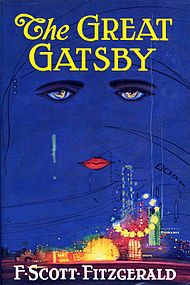
The Great Gatsby

Hello, it's Heather here! I realised a few hours ago that I've accidentally avoided reviewing any books that our English Literature class has studied, which is odd considering how good they've all been. So, here's one on The Great Gatsby.

Author: F. Scott Fitzgerald
Published: 1925
Publisher: Charles Scribner's Sons
My rating: ★★★★

The symbolism is so obvious in this book; it’s like a canary yellow car hit you with the hidden meanings. It’s quite understandable why The Great Gatsby is well-renowned in the English Literature world, flick to any page and it’s like a recipe for how to write a decent novel (2 tablespoons of foreshadowing, 100 grams of metaphors and a pinch of alliteration). If you haven’t already read The Great Gatsby, then do it right now.
Fitzgerald echoes his own relationship through the novel, making the reader feel pity for Gatsby upon first reading. Some of the writing is beautiful, like how Daisy blossomed like a flower for Gatsby on their first kiss. There should be more books set in the Jazz Age; it is simply an enchanting time for a story to be set, what with the glamour and sparkles of the rich mixed with the many people unable to quite reach it. The plot itself is intriguing, especially thanks to Nick, who I loved as a protagonist. Nick lies so many times, he paints himself out to be virtuous and humble and positive, and outwardly it may seem that this is true – but the true Nick is jam-packed with judgement, he is so unbelievably blunt and conclusive that it’s almost laughable. I suppose this is all part of the green-light illusion, Nick can see this version of himself, but it’s untouchable in a society where materialism is valued so highly. The American Dream is far from the main focus of the novel, but having just looked at Merton in sociology, I can certainly see how strain theory is in place. Gatsby being the working class boy that dreamt of a grand lifestyle only obtainable through illegitimate means and having fully gained the respect and rewards he wanted via these methods. The ambiguous nature of a lot of the book makes it interesting to analyse, we never truly know if Gatsby tells Nick the truth, we never quite learn how Nick ends up in most scenarios or why he feels that if he does not interfere or reveal any secrets, he will be the better man.
As I said before, symbolism is paramount in the book. Literally everything can be seen in a different way, which makes it fun to write essays about… take the green light at the end of Gatsby’s dock and ponder these three explanations. Green is corresponded with safety, so Gatsby wistfully looks upon the light as he thinks of his family and the quiet life he left behind in exchange for quite a savage world of gangs and parties. Green can be associated with healing, so Gatsby wants someone to mend the heart that has been hurting for such a long time now. In some countries, green is the colour of money so he yearns for more and more money, mirroring that consumerist life the upper class indulged in. The list goes on, but you get the picture. I remember writing my notes about The Great Gatsby and coming across a random comment about purchasing oranges and lemons – this was so exciting for me that I soon had a substantial debate outlining how these objects clearly showed that Gatsby is being mocked by a song about bells for having a lack of morals (chances are he just liked fruit, or Fitzgerald wanted to demonstrate his wealth). Sadly, that chunk of notes has never made it into one of my essays, but I wait in anticipation for the day someone asks me about the significance of oranges and lemons featuring in The Great Gatsby.
It's good to consider love in the book, since nobody really gets a fairy-tale ending; reciprocated true love is arguably absent from the book. Shani and I are huge ‘shippers’ of Nick and Jay – Nick even says his smile was gorgeous! Nick is so blinded with admiration that the book is smothered in positive language about Gatsby despite several others claiming he’s got some dodgy money-making ways and is rumoured to be related to very scandalous people indeed. Gatsby grins and Nick swoons like my fellow bloggers do when I present them with hardback books. Gatsby does not reciprocate and seems to be completely oblivious, which is probably a good thing considering the historical context.
This book review was more of a ramble (and an excuse to finally pent out my love for oranges and lemons), so apologies for that, but let me know what you thought of The Great Gatsby if you have read it.   

Sunday, 2 October 2016

Flash Drama

Set in a basement of a house, a man is locked up for the murders he has committed. While he sleeps on a wooden stool, his conscious comes out from his body and realizes and remarks in what he has done.
Wakes up form his death like sleep.

Jeremy: Why am I covered in a cloak of staining red! I taste it on my tongue with metallic disgust. I see it through my eyes; it tinges my vision with thick scarlet. This is not my blood. (He looks to the body asleep on the stool.) What have you done you monster! Caked in red mud! What is this place? A dungeon? A basement! There are no windows except the small peephole in the corner over there. (Points to the left hand corner behind him.) The dark is too suffocating; it engulfs me and swallows me whole. I am the victim left in the beast’s fangs, forever trapped in its warm saliva. He is the monster! (Gestures to the body.) I am the fool who was deceived by his kind face, but no, what lives in his mind is so grotesque and demonic that it would scare you half blind. He sleeps so peacefully now, but when awakes he churns and twitches of whom is next victim will be. (Breaths deeply) He killed my wife, Sarah. Lovely, kind benevolent Sarah, he stole her spirit away in an act of madness. He could not stand her good will and graces, for her vast beauty reflected her inside. (He weeps) My love, (He looks up, holdings is palms together) do not think me evil, it was the other who did you wrong. Indeed I was present, but trapped in the mind of a demon. (He whispers, “I love you”) I do not deserve to be in this cave of a place, to have blood of another on my innocent skin. (Rubs his hands together) I am not the monster with ‘terrible teeth and terrible claws’; I am not the one who is the chill in a nightmare. I am not the curse of the living. My heartbeats and pounds against the chest, (Puts his hand over his heart) but I am beguiled in the brain of a soulless man. Yet his heart never contracts, but he still stands.
Wake up you hellion! (He shouts, and kicks the shin of the body.)

-       Red eyes are now alert and awake and the body rises.

- Lights out, end of scene.


Hey guys!! Its Lydia here, sorry its been so long since I last posted anything, I've been very busy with school work! Here's something I recently did for my creative writing class. 
Leave me a comment and tell me what you think.